
“Finance, technology, and the changes shaping tomorrow.”
Why Did Apple Stop Using Intel Chips in MacBooks?
For many years, MacBooks were powered by Intel processors.
At the time, it seemed like the perfect partnership. Apple had fast computers, broad software compatibility, and access to some of the most advanced processor technology in the industry.
But over time, a major problem started to appear.
Intel chips were becoming more powerful… but also hotter, louder, and far less power efficient.
And that began to conflict with what Apple values most:
thin design, long battery life, and a smooth user experience.
While Apple’s iPhones kept getting faster and more efficient thanks to Apple’s own A-series chips, MacBooks remained dependent on Intel. Eventually, the difference became impossible to ignore.
Apple realized something important before most companies did:
The future of computers wouldn’t be just “more power.”
It would be power combined with efficiency.
That meant:
less heat,
lower power consumption,
longer battery life,
quieter systems,
and better performance at the same time.
The problem was that Intel was struggling to evolve in that direction.
Intel-based MacBooks started gaining a reputation for:
overheating,
constantly running loud fans,
throttling performance under pressure,
and delivering weaker battery life compared to even some newer Windows laptops.
Meanwhile, Apple had already mastered chip development through the iPhone and iPad.
So the company made a historic decision:
to build its own processors for the Mac.
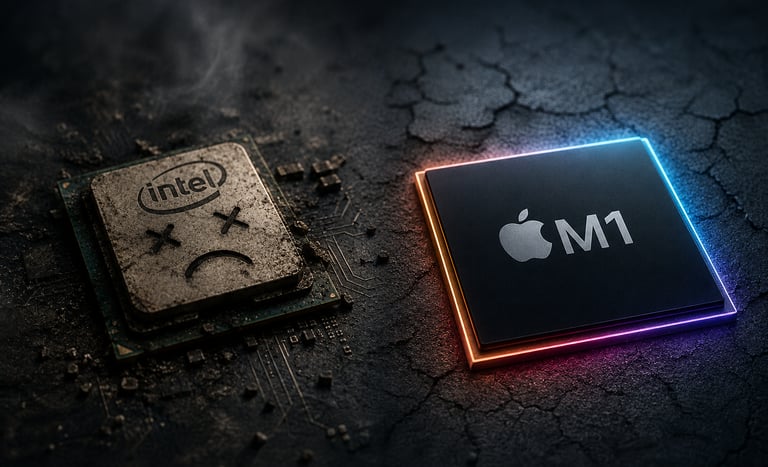
That’s when the Apple M1 chip was born.
And the impact was massive.
When the first M1 MacBook launched, many people expected it to be “good for battery life.”
Instead, it shocked the entire tech industry.
The M1 MacBook Air became:
incredibly fast,
almost completely silent,
highly power efficient,
and capable of competing with much larger and more expensive laptops.
The biggest difference was the architecture.
Intel processors were based on the x86 architecture, a system originally designed decades ago for traditional desktop computing.
Apple’s M-series chips use ARM architecture, which is significantly more energy efficient. It’s the same core technology used in iPhones.
That allowed Apple to create something rare:
a laptop with professional-grade performance… but with power consumption closer to a tablet.
There’s also another strategic advantage that most people rarely talk about.
By moving away from Intel, Apple gained complete control over its own future.
Now Apple controls:
the hardware,
the software,
the chip design,
AI integration,
battery optimization,
security,
and overall system performance.
In other words, macOS is now designed specifically to run on chips engineered by Apple itself.
That’s one of the reasons modern MacBooks feel so fluid and responsive, even without extreme amounts of RAM or aggressive clock speeds.
Everything was designed to work together.
The transition also benefited Apple financially.
Building its own chips reduces external dependency, increases profit margins, and allows Apple to release new technologies on its own schedule — without waiting for Intel.
Today, the Apple M5 lineup shows just how far that strategy has evolved.
Modern MacBooks can:
edit 8K video,
run AI workloads,
handle software development,
render complex graphics,
and maintain long battery life for hours.
And perhaps most impressively:
they can often do all of that without the heat and fan noise that were common in older Intel-based models.
In the end, Apple didn’t abandon Intel because Intel chips were weak.
It left Intel because it wanted complete control over the next generation of computing.
© 2025. All rights reserved.