
The difference between the iPhone 17 Pro Max chip and the MacBook Pro M5
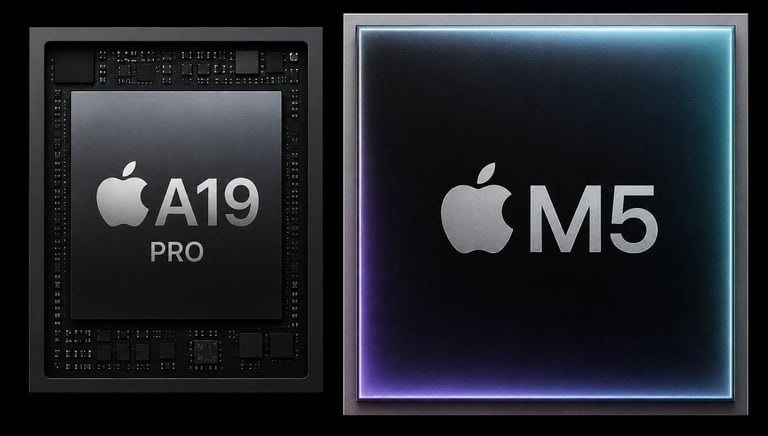
The difference between the iPhone 17 Pro Max chip and the MacBook Pro M5 chip may seem small in the name… but in reality, it’s almost like comparing the engine of a high-performance sports car to the engine of a racing truck.
Both are incredibly fast.
Both are built on Apple architecture.
Both were designed for AI, graphics, and multitasking.
But they were created for completely different purposes.
The iPhone 17 Pro Max chip, the A19 Pro, was engineered to deliver maximum power inside an extremely small space. It has to stay fast without overheating, draining too much battery, or requiring a large cooling system — all inside a thin device that fits in your pocket. That’s why its efficiency is so impressive.
The M5 chip inside the MacBook Pro was designed for sustained heavy performance. It doesn’t need to prioritize energy efficiency the same way because it operates inside a larger machine with better cooling, a bigger battery, and far more room for heat dissipation.
And in real-world usage, that changes everything.
The A19 Pro is optimized for:
launching apps instantly,
recording high-quality video,
running mobile games,
handling on-device AI,
processing computational photography,
and doing all of that while consuming minimal power.
The M5, on the other hand, was built for:
editing 4K and 8K video,
software development,
3D rendering,
AI workloads,
running dozens of tabs and applications simultaneously,
using professional creative software,
and maintaining high performance for hours without slowing down.
One of the biggest differences is memory architecture.
The iPhone uses a more limited memory configuration because the system must conserve both space and power.
The MacBook Pro M5 uses significantly faster unified memory with dramatically higher bandwidth. Some versions exceed 150 GB/s of memory bandwidth.
And that matters because modern performance isn’t just about CPU speed anymore.
It’s also about how quickly the system can move data.
That’s why:
an iPhone can export a video surprisingly fast,
while a MacBook can edit multiple massive video files simultaneously without lagging.
The GPU architecture is also very different.
The A19 Pro features a powerful mobile GPU focused on gaming, ray tracing, and advanced mobile graphics.
The M5 includes larger GPUs, more graphics cores, and vastly superior sustained graphical performance — especially in the Pro and Max variants.
And there’s one difference most people never notice:
The iPhone chip was designed for short bursts of extreme performance.
The Mac chip was designed for continuous computational endurance.
In other words:
the iPhone can become unbelievably fast for a few seconds,
while the MacBook can remain extremely fast for hours under heavy workloads.
That’s why iPhones often perform amazingly in short benchmark tests… but MacBooks dominate in real professional workflows.
The simplest way to understand it is this:
The A19 Pro is like an Olympic sprinter.
The M5 is like an Olympic marathon athlete carrying weight.
Both are extraordinary.
But they were built for completely different battles.
© 2025. All rights reserved.